
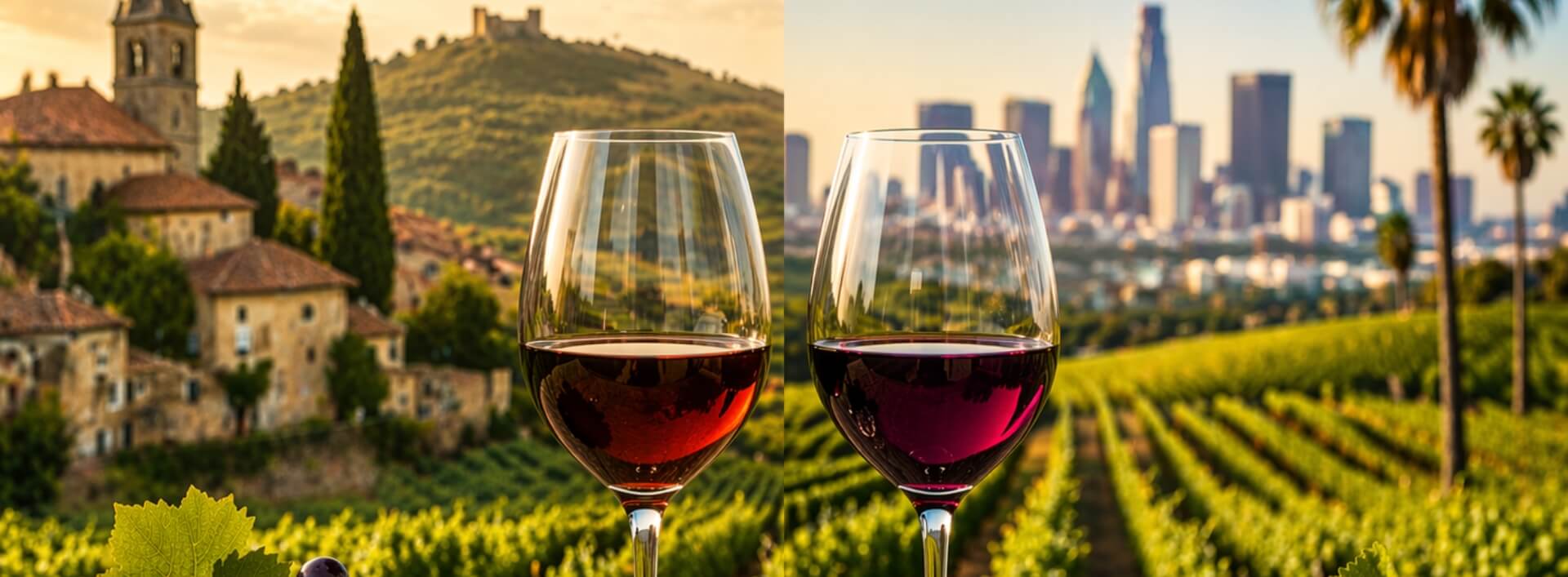
The wine world is often divided into two broad categories: Old World and New World. At first glance, the terminology seems simple—and it is—but it also tells a deeper story about tradition, geography, and how wine has evolved over time.
What is “Old World” Wine?
“Old World” refers to the historic wine-producing countries of Europe, places like France, Italy, Spain, Germany, and Greece. These regions have been cultivating grapes and refining winemaking techniques for thousands of years, setting the standards that much of the wine world still follows today.
While they weren’t the very first to produce wine (that distinction belongs to Georgia, nestled near the Black Sea), they were instrumental in shaping wine culture, trade, and classification systems.
Old World wines are typically associated with tradition, structure, and a strong sense of place. Rather than emphasizing the grape variety on the label, these wines often highlight where the grapes were grown.
What is “New World” Wine?
“New World” refers to wine-producing countries outside of Europe, including United States, Australia, New Zealand, Chile, Argentina, and South Africa.
These regions embraced winemaking later, often bringing innovation, experimentation, and a more modern approach to the craft. New World wines tend to be fruit-forward, approachable, and clearly labeled, making them especially accessible to newer wine drinkers.
A Tale of Two Systems: Labeling and Classification
One of the biggest differences between Old World and New World wines lies in how they are labeled and classified.
In Old World countries, strict regulations govern how wine is produced and labeled. These systems are designed to preserve regional identity and ensure quality, but they can also be complex.
Take France as an example. Wines are organized by geographic areas called appellations, such as those within the Loire Valley. These are further classified under systems like Appellation d’Origine Contrôlée (AOC), which sets rules around grape varieties, yields, and production methods.
Similarly, Italy uses its own hierarchy:
- Vino da Tavola (table wine)
- IGT (Indicazione Geografica Tipica)
- DOC (Denominazione di Origine Controllata)
- DOCG (Denominazione di Origine Controllata e Garantita)
Each level reflects increasing regulation and, generally, perceived quality.
In contrast, New World wines, especially those from the United States, focus more on clarity for the consumer. Labels typically include:
- Producer name
- Grape varietal (e.g., Cabernet Sauvignon, Chardonnay)
- Vintage (year of harvest)
- Alcohol content
- Sometimes the region of origin
The U.S. does have designated growing regions called American Viticultural Areas (AVAs), but unlike European systems, these are not ranked by quality.
Why Do They Taste Different?
Even when made from the same grape, Old World and New World wines can taste surprisingly different. The reason comes down to a combination of factors:
- Terroir (soil, climate, and geography)
- Latitude and sunlight exposure
- Winemaking techniques and philosophy
Old World wines often lean toward earthy, mineral-driven, and restrained profiles, while New World wines tend to be riper, bolder, and more fruit-forward.
The Bottom Line
There’s no “better” between Old World and New World, only different expressions of the same grapes. Understanding the distinction helps you navigate wine labels, expand your palate, and discover new favorites.
So next time you reach for a bottle, try a side-by-side comparison: your favorite varietal from two different parts of the world. You might like one more than the other, but chances are, you’ll learn something (and enjoy the process) along the way. 🍷